

Aerial Spraying – CAA acknowledges communication difficulties

July 2011 - Aerial spraying behind Ardentinny

For those of you who regularly read this site, you will already be aware that aerial spraying took place over Ardentinny, for the second year running, in July of this year. This happened without any apparent forewarning, despite an undertaking from Forestry Commission Scotland (FCS) last year that notice of any future aerial spraying would be communicated to the public, in advance. Consequently Ardentinny.org contacted FCS and there ensued various correspondence, all reported here, regarding whose responsibility it was to inform the public and who had done what, in that regard. Two of our site visitors were kind enough to supply evidence of what was required by law in England and Wales and we checked with the Scottish Environmental Protection Agency (SEPA) and it confirmed that the rules regarding signage also applied in Scotland.

FCS then provided information supplied by the helicopter company, MFH Helicopters Ltd., who undertook the spraying, which said that warning signs had been posted but could give no further detail (see Aerial spraying – the future). As we were invited to deal directly with Mr. Hawkings-Byass of MFH Helicopters, we did so on 27 September, 2011 asking if his company retained the data required in their Aerial Application Certificate which was detail of the company’s procedures for the provision and positioning of warning signs within 60m of the land to be treated so as to warn pedestrians, drivers and others of the activity. In addition we asked: How many signs were posted; when they were posted, the wordage of the signs; and their exact location, preferably with map co-ordinates. Mr. Hawkings-Byass responded to say that he would reply to our questions on 3rd October. On hearing nothing further, on 11th October we wrote to the Civil Aviation Authority (CAA) requesting said information, in the knowledge that it is one of their requirements when issuing the appropriate license.

On 14 October we received the following response from MFH Helicopters Ltd:

I apologise for the delay in replying but I have been away. I am sorry that I am not able to produce much more information than I have already. As I have stated already we are not obliged to keep records of where and when signs are posted. All our ground vehicles carry such signs.

Since the regulation was introduced, open access has required us to re-evaluate the measures we take with regard to 3rd parties and these will be particular to each location and its relevant circumstances.

Kind regards,

Nicholas Hawkings-Byass

and on the 26th October we received the following response from the CAA:

MFH Helicopters are granted their annual Aerial Application Certificate on the basis of a number of items including an Operations Manual that states how the spraying operations are to be conducted. In compiling this manual the guidance in our CAA publication CAP 414“The Aerial Application Certificate” is followed, which states,amongst other things, how warnings should be posted to nearby residents etc. I can confirm that the MFH Operations Manual does contain instructions to its crews to post warning notices on public roads and footpaths within 60m of the boundary of the land to be treated.

The CAA carry out an annual inspection (audit) of the field operations of Aerial Application Certificate holders including MFH. The most recent inspection took place in July of this yea rand there were no findings that would have justified suspending MFH’s certificate.

I understand that you are having a constructive dialogue with MFH in order to ensure that the warning signs are posted where they can be readily seen and fulfil their purpose. If the warning sign system is not proving effective we would reasonably expect MFH to use additional media(websites/local liaison etc)to ensure fair warning is given and the local effected local populace are aware of what is taking place.

Regards,

Lawrence Hay

Encouraged by the CAA’s approach to ‘ensuring fair warning is given and the local effected populace are aware of what is taking place’ we asked if the CAA would communicate this to HMF Helicopters as, apart from Community Council members, it seemed that neither the local residents, nor the general public visiting the village on the day the spraying took place, were aware of it and that hill and forest walkers at the time reported they saw no warning signs. On 1 November, 2011 we received this response from Mr. Lawrence Hay of the CAA:

I will discuss the use of additional media with MFH and they were copied in on my last e-mail to you. I am having a regular dialogue with MFH on the future of aerial spraying as this has been under threat due to various EU decisions. The UK is seeking to continue having aerial application of asulox/asulam as an option since its only present use here is for this type of conservation work. The use of helicopters is regarded as less invasive in remote environmentally sensitive areas (typically rural hill sites and moors) because they do not have to use tracks and paths or leave a surface ‘footprint’.

I note that the Community Council did not have the opportunity to pass on information to the residents of Ardentinny and that some of the posted signs were missed. From my dealings with other operators, this problem of communication is one of the hardest to get right especially as they are at the sites for a very brief time; it may well be that some of the places that signs are posted are not the same places that would be obvious to those with local knowledge.

It would help if a local liaison point/person were established so that prior to operations, critical information could be passed on to the right people and the benefit of local knowledge obtained.

Regards,

Lawrence Hay

While the lack of forewarning of spraying, which should include the name of the substance being employed, has been our main concern, it is interesting to note that the chemical used appears to be of concern on many fronts, though perhaps for different reasons. However, it is heartening to see that there is a will to overcome past failures to forewarn the public and to ensure that this does not recur.

Related links:

Asulam (Wikipedia)
ASULOX UPDATE Oct 2011 (MFH Helicopters)
MFH Bracken Control Brochure 2011 (MFH Helicopters)
CAA Aerial Application Certificate
SEPA: Bracken Control – A Guide to Best Practice
Bracken Eradication (The Scottish Government)
Bracken & Asulox FAQ (MFH Helicopters)
Asulam Voted for Non Approval (Sept. 2011 – United Phosphorus Ltd)
Asulox supplies (Oct. 2011 – United Phosphorus Ltd)
Asulox ban a blow to Scottish farmers – Lyon (Scottish Liberal Democrats)
Uplands protest over ban on bracken spray (The Guardian)
Farmers urged to act over bracken control agent asulam (Farmers Guardian)

Fireworks frighten horses (and other animals!)

For many people Bonfire Night is an enjoyable evening watching spectacular firework displays and warming themselves by a bonfire, but for horse owners it can be a time of concern and distress.
Fireworks can frighten even the most sensible horse, so all horse owners should be prepared for the firework season. The British Horse Society (BHS) has issued the following advice for owners:
Fireworks must not be set off near livestock or horses in fields or stables
It is best to keep your horse in its normal routine
Risk assess your stable yard and plan to limit disturbance
Ensure you find out if there are any displays planned nearby
Warn local organisers, councils and schools that there are horses in the area
Organise your plans in advance
Remain calm and positive yourself as horses will sense your unease
Keep your horse in a familiar environment
Safety for everyone is the key – do not put yourself in danger
This advice is available as a downloadable poster, along with further information from www.horseaccidents.org.uk.
The BHS also supports the Blue Cross guidelines on Fireworks and Animals which is available at www.bluecross.org.uk and in paper format from both the Blue Cross and the BHS.
It is not just horse owners who need to be careful. People organising firework displays should inform local horse owners and it is also a good idea not to let off fireworks anywhere near fields or farms. Most people don’t realise how much suffering fireworks cause animals, particularly horses. Those who really want to have fireworks in their back garden should think carefully about how it will affect local pets and animals before they do so.

By being proactive in planning for fireworks and Bonfire Night, you can make the annual celebrations less stressful for you and your horse.

Useful resources:
www.horseaccidents.org.uk.
SSPCA – Fireworks.
RSPCA – Bang! Fireworks frighten animals.

Boats, Buses, Fly-tipping, and Signs.

These appeared to be the major issues arising at the last Community Council meeting held on 4 October 2011.

All community councillors, bar one, were in attendance, along with seven others, who listened to the lengthy agenda which included the following:

Police Report
The police reported one crime of fire raising of the public toilets at the beach. Someone has been charged and it has been requested that any community service they might be asked to do, be undertaken in Ardentinny. When asked if there was any more news on the fires at the caravan site or the drugs raid at the same location, it was reported that an investigation into the former is still ongoing and that the latter case has not yet gone to court. Apparently the police now try to visit Ardentinny twice a shift and the public are invited to approach them regarding any concerns they might have.

Treasurer’s Report
The Treasurer reported expenditure of £20 for Scottish Rights of Way membership subscription and a bank balance of £2049.54 pence.

Forestry Commission’s report
Jessie Crowe reported that the Forestry Commission plan to replace the destroyed beach toilets when funding is available and in the meantime they will leave the portaloos which are in place.

Fencing of the Nursery Field continues to be delayed until the owner of the caravan site completes the work he intends to do.

The rhododendron cutting programme is ongoing; the hedge cutting programme is still delayed until the contractor’s machine is functioning and the Stronvochlan Road work is still on their programme.

The Water to the bowling club will be left on for October after which it will be turned off to avoid frost damage.

Regarding previous discussion regarding the Carrick-Ardentinny route. The Forestry Commission does not intend to erect a bridge or handrail, as suggested and the risk assessment paperwork is available for Stephen Johnstone to inspect, as requested. Someone from FCS is also willing to walk the route with Stephen, at Stephen’s convenience. Jessie also said that distances on the route are marked on the finger posts but it is not possible to state how long the walk will take as it varies from walker to walker.

Questions arising from the FCS report focused on the responsibility of the control of Japanese knotweed on the shore. Suggestions were given on who to contact for advice and training.

Boats
Concerns from the regional to the very local were discussed. The first being the proposal by the Department of Transport to remove the Clyde coastguard service in order to make a saving of 1.4 million. Should this go forward, any calls for assistance in the Clyde area will be handled by Ireland or Aberdeen and this lack of local knowledge could be potentially life-threatening. Sandra Davidson explained that the lifeboats will remain but those controlling them will not know the area as well as the Clyde coastguard and while sailors can often describe where they are, giving local landmarks, they may be unable to give their map coordinates. The Convener read aloud a standard letter of protest addressed to the Right Honourable Philip Hammond, MP which the Community Council could send, if agreed. However, she also asked those present if they had any further local knowledge which might usefully be added. Sandra Davidson promised to email her a paragraph with the information requested.

The second ‘boat’ issue was that of an abandoned boat on Ardentinny beach. It was reported that this had been donated by the owner to a charity auction and had been won by a resident who plans to remove it.

Buses
Councillor Marshall announced that the Sligrachan Sunday bus service would end on the 23rd of October. The new Sunday timetable is available here.

Fly-tipping
In addition to the concern regarding the abandoned boat on Ardentinny beach, it now seems that the area surrounding it has become a tip and Councillor Bruce Marshall was asked if a Council uplift of the offending tipped material could be organised. He agreed to liaise with Teresa Forsyth and try and organise an uplift, as requested.

Signs
Signs of a various nature were a recurring topic for discussion. The Forestry Commission is considering putting up additional signage at the Ardentinny end of the Carrick- Ardentinny route. The content of new signage on the Larach continued to be debated. Councillor Marshall requested a copy of the previous police input on this matter and promised to take it to the appropriate department for consideration.

The Convener also raised an issue, which had been carried forward from the previous meeting, regarding the level of responsibility the Community Council should take to inform residents, by way of a notice, of any future aerial spraying. After some discussion it was agreed that it was the legal responsibility of the contractor to put up signs warning the public and not that of the community council. After further discussion regarding whether or not the legally required signage had been put in place by the contractor and whether the Community Council was required to further inform the community, the Convener suggested that this would be discussed with other Community Councils to establish their responsibility on the issue. It was also agreed that the Community Council would write to the Helicopter Company asking them for details on the content and the location of the signs they claim to have put up. The Convener said she would draft a letter and circulate to all Community Councillors for their feedback & also try and get feedback from the next Caucus.
Ardentinny Community Council meeting Minutes 4 October, 2011 (pdf).

New Ardentinny bus timetables published

The new Ardentinny bus timetable comes into effect on 23 October, 2011. The main change for Ardentinny residents and visitors is that the Sunday bus service will now amalgamate with the Toward service and become the 489. The Sunday 489 service will terminate at Ardentinny Car Park and will run four return journeys from Dunoon at 09.30, 11.30, 14.30 and 16.30. One positive aspect of the change in Sunday services will be the ability for Ardentinny residents to now travel to Toward Lighthouse without the need to change buses!

Download 485 timetable (PDF)
Download 489 timetable (PDF)

Glenfinart Garden project welcomes Cowalfest walkers

Diane McCormack, Cowalfest Organiser; James Gordon, Ardentinny Trust Deputy Convener; a Cowalfest walker; Dennis Gower, Trust Convener.

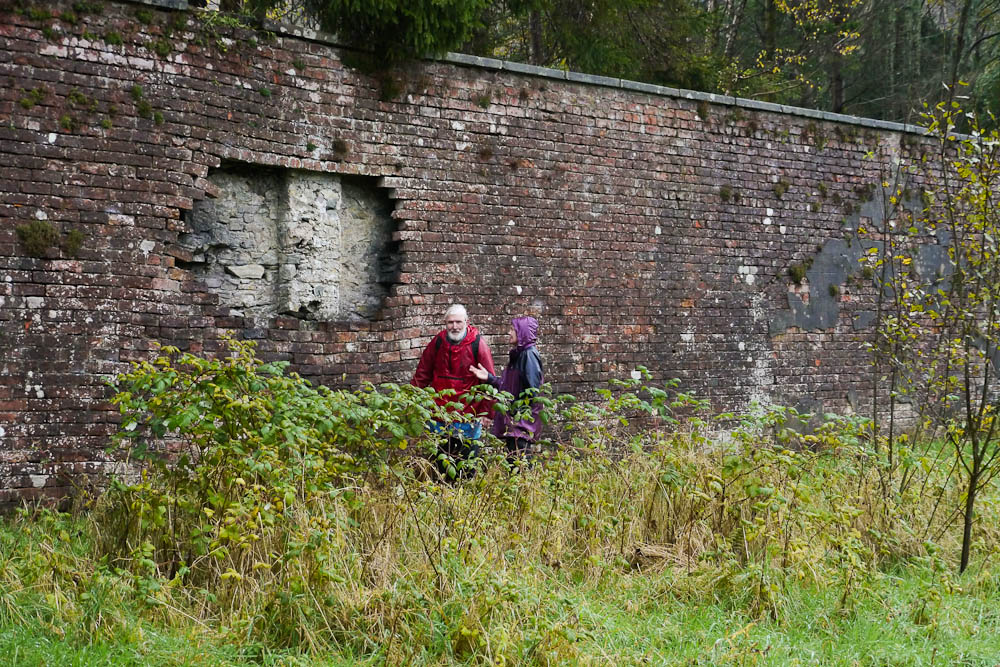
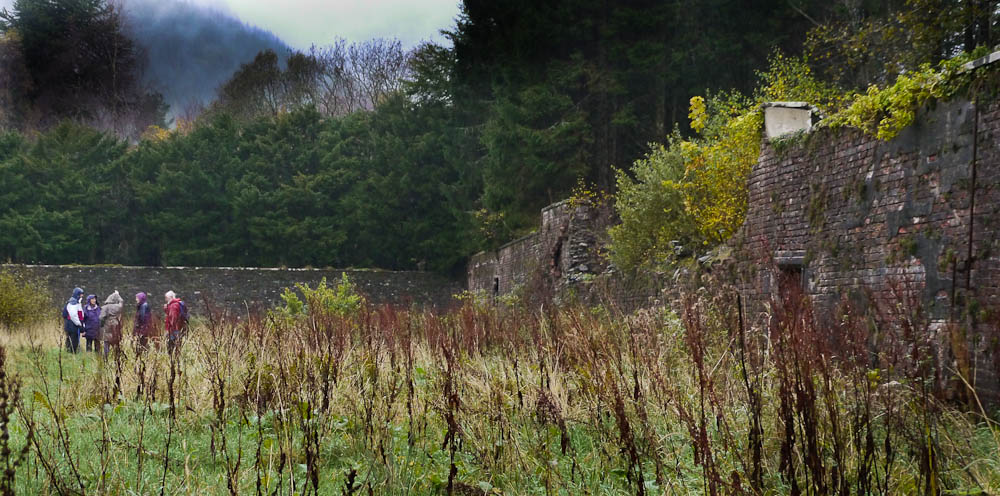
Despite the rain, Ardentinny Community Trust welcomed Cowalfest walkers to Glenfinart Walled Garden on Saturday 15th October. Walkers were able to go around the garden and also view a small exhibition on the project.

It was a plan hatched at a Highlands and Islands Enterprise conference in Ardfern last year. There, Cowalfest organiser, Diane McCormack met with Trust members and suggested they might like to include the Glenfinart garden in this year’s programme.

The Trust hopes to build on this and have garden visits and walks included in Cowalfest 2012.